
Monday, October 26, 2026
Remote inspection or site visit: criteria for choosing how to inspect a claim
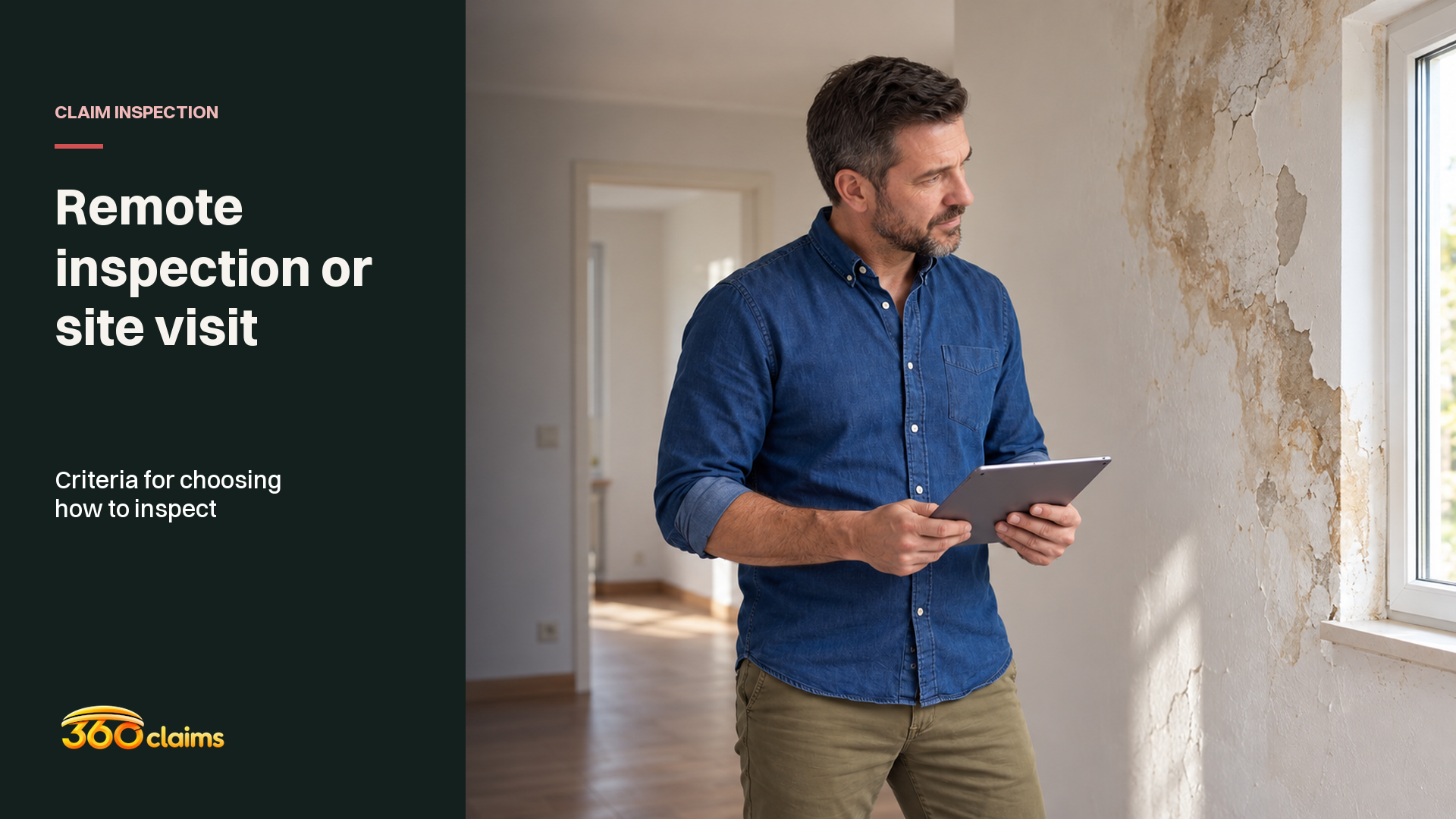
A video call can show damage. The question is whether it allows the checks that the case file needs.
Choosing between a remote inspection and a site visit should not come down to which option fits the diary better. Nor should a method be assigned automatically based on the type of claim. Two apparently similar instances of damage may require different checks.
We suggest an approach to the decision: start with what needs to be established, check what can be observed and recognise the limits of each intervention. This does not replace the terms of the assignment or the judgement of the responsible professional.
First, define what you need to check
Observing the appearance of a finish is different from determining the source of damp or checking an inaccessible element.
Before choosing the method, state the technical question precisely. "See the damage" is too broad. "Check which areas show visible damage and how it is distributed" makes it easier to assess what a remote inspection can contribute.
Also distinguish an initial observation from the checks needed to reach a conclusion. The fact that the first can be carried out remotely does not mean that all the work can be resolved that way.
Four questions for assessing the method
1. Can the important features be seen? Check whether both the overall view and the relevant details can be shown. A partial image may omit precisely the relationship between elements that you need to analyse.
2. Is the image clear enough to distinguish them? Lighting, focus and connection stability affect what can be observed. If a detail cannot be seen, the prudent approach is to record it as unchecked, rather than interpret it as absent.
3. Is a direct check needed? If a conclusion depends on a measurement, a test or an area that is not visible, specify how that information can be obtained. Depending on the case, the answer may be additional documentation, technical intervention or a site visit.
4. Can the area be shown safely? A remote inspection must not lead to asking someone to climb onto a roof, dismantle elements or expose themselves to risk to obtain an image. An access limitation requires the proposed intervention to be reconsidered.
Two fictional examples
A limited check. The assignment requires observing the current appearance of an interior finish after a repair that has already been documented. The area is accessible and the images allow it to be examined clearly. The adjuster can assess whether a remote intervention is sufficient for that specific check, without extending it to aspects that have not been verified.
A question that remains open. During a video call, a stain is observed on a ceiling, but its source cannot be determined from what is shown. The session provides information, although it does not resolve that question. The additional check required must be defined, and it may call for an intervention on site.
Changing the method is also progress
Starting remotely does not mean having to finish remotely. What matters is making clear what has been observed, what remains unchecked and what intervention would resolve it. Physical presence alone does not guarantee that every question will be answered either.
360 Claims brings remote inspections, communications, documentation and technical work together around the case file. Created by adjusters for adjusters, it supports the practice's operations; the choice of inspection method and the conclusions remain professional decisions.
Would you like to see how site visits and remote inspections fit into your practice's operations?
Further reading
Before reviewing a loss adjusting report: what your team needs to have at handhttps://360claims.app/en/blog/before-reviewing-a-loss-adjusting-report/
Discover 360 Claimshttps://360claims.app/en/product/