
Monday, October 19, 2026
Before reviewing a loss adjusting report: what your team needs to have at hand
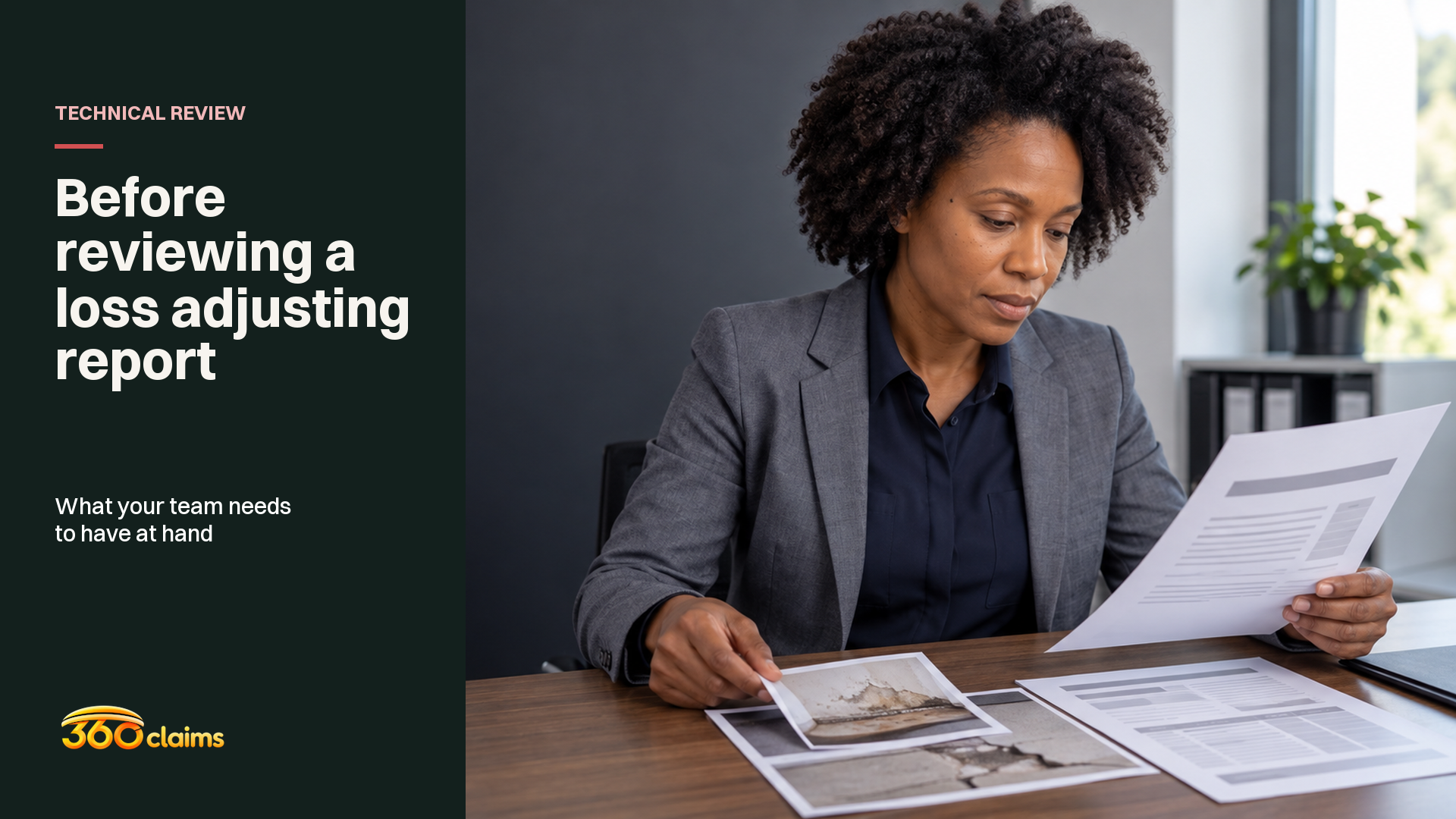
Reviewing a loss adjusting report starts with understanding the work behind it. To assess whether it explains the claim clearly, maintains technical consistency and addresses the assignment, the reviewer needs to know what came before it.
Consider a fictional example. An adjuster submits a draft after a visit and after receiving additional documentation. Several questions arise during review: is the estimate used the latest one received? Did anything change after the visit? Is there a technical question still to clarify? Do the photographs support the description?
Answering these questions requires having the case file's context at hand. This approach helps prepare the review and make the comments returned to the adjuster more specific.
The assignment and its scope
Start with the reason for the intervention: what has been requested, what the professional needs to analyse and what limits apply to the work.
A brief reference to the purpose of the assessment makes it possible to check whether the report answers the request. It also helps identify a question that needs clarifying before proceeding: a later request may change the original scope and should be identified.
The reviewer should be able to explain which question the report needs to resolve and whether any condition limits the analysis.
The background that explains the analysis
The initial statement, policy information, earlier photographs or instructions received during handling may be relevant to interpreting the report.
Identify the background supporting the technical decisions. If a piece of information influences a conclusion, the reviewer should be able to find it and understand its source.
Distinguish documented facts, statements by the parties and the professional's assessments. This makes it clearer what has been checked, what has been reported and what forms part of the adjuster's reasoning.
The documentation used
Estimates, invoices, photographs and measurements may arrive at different times. Before reviewing, the team needs to know which have been considered and which are still outstanding.
A simple approach is to prepare a list of the documents used, including their dates where relevant. If a corrected estimate was received, indicate which version was used and what effect the change has. If documentation that could affect the analysis is missing, that absence should be visible.
The reference should make it possible to find the document supporting the text or valuation, without having to infer which of several files it is.
Changes and open questions
New information, corrections or clarifications may arise between the visit and submission. A brief summary of what has changed directs the review towards points that need another reading. The original sources should remain available for checking.
There may also be open questions when the draft reaches a supervisor. Identifying them makes it possible to assess whether they affect the content, a conclusion or a later check. Each outstanding issue should explain what is missing, why it matters and who can resolve it.
The team can agree a short handover note covering the scope, documentation used, relevant changes and open questions. Its usefulness depends on capturing what that particular case file needs.
Comments that help the work move forward
With that background at hand, the review can follow the relationship between the assignment, the available evidence, the analysis and the conclusions.
When returning a comment, specify the point and the reason. "Review valuation" leaves many interpretations open. "Check whether the measurement used corresponds to the corrected estimate" identifies the check and allows the adjuster to respond precisely.
How 360 Claims supports this process
360 Claims brings documentation, communications, activity and technical work together around the case file. Reports are prepared from the work performed, with review by the adjuster and supervision by the practice.
That organisation makes it possible to consult the background alongside the work being reviewed. Technical judgement and validation of the report remain with the responsible professionals.
Would you like to see it applied to your team's way of working? In a demo, you can review how case files, documentation and technical work connect in 360 Claims.