
Monday, November 2, 2026
A stain does not explain the claim: from observed damage to an established cause
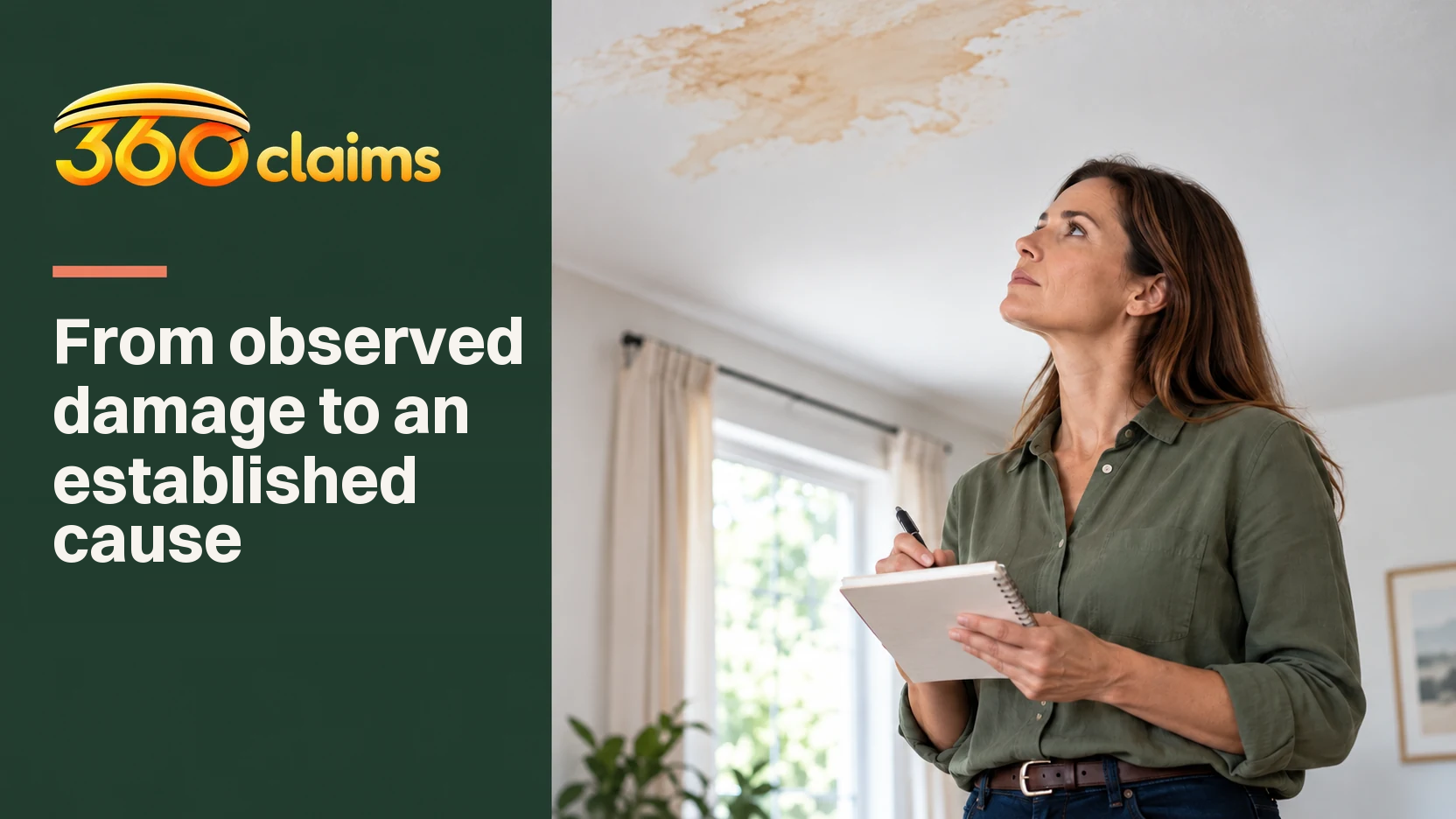
A photograph arrives showing a stain on a ceiling. The assignment already includes an explanation: "a leak from the flat above". The image shows an alteration, but it remains to be checked whether that explanation describes what happened.
For the adjuster, this is precisely where the work begins: distinguishing what can be observed from what someone assumes and from what the checks support as a conclusion.
In damp damage, identifying the source can be complex. RICS guidance emphasises locating where the moisture comes from, rather than stopping at a label describing how it appears or moves.
Three levels to keep separate
Observation describes what has been checked: where the alteration is, what it looks like and which elements could be examined. It allows the finding to be understood without treating its explanation as settled.
A hypothesis proposes a possible cause and the information that would allow it to be tested. An explanation provided by the occupant may guide the investigation, but it remains reported information until supported by checks.
The conclusion explains which interpretation the available evidence supports and within what limits. The person reading the report should be able to follow the relationship between the findings and the professional reasoning.
This distinction matters particularly when an initial explanation starts being repeated in emails and conversations. Repeating it does not add a new check.
A fictional example: the stain that appears after rain
Imagine an assignment concerning a stain on a bedroom ceiling. The occupant says they noticed it after several days of rain. They also mention that a nearby installation was recently repaired.
Both pieces of background deserve attention. Neither, on its own, establishes the source of the damage.
To organise the reasoning, distinguish:
- Which alterations have been observed directly.
- Which dates and events come from other people's accounts.
- Which evidence supports each explanation and which information casts doubt on it.
- Which check would distinguish between the open hypotheses.
The example does not allow a cause to be selected. It shows how to avoid letting the first account determine the conclusion before it has been tested.
A specific uncertainty is more useful than a general caveat
Instead of "there may be a leak", it can be stated more precisely: "A stain is observed on the ceiling. The checks carried out have not determined its source".
The next step is to explain which question remains open and which professional intervention is proposed to resolve it, within the scope of the assignment. The appropriate check will depend on the building, its installations and the circumstances of the claim.
The joint work by Historic England, RICS and the Property Care Association on traditional buildings also stresses the importance of investigating causes and understanding the building, rather than treating only the manifestations of damp. Its scope is that type of construction, rather than an automatic rule for every building.
Keeping the context when the file changes hands
When someone else takes over a case file, they need to understand what was observed, which explanations were considered and what supported the conclusion. If some of that information stayed in an email, some in a conversation and some in visit notes, reconstructing the reasoning adds work to the review.
360 Claims brings documentation, communications and technical work together around the case file. That context supports the practice's work; interpreting the evidence and reaching the loss adjusting conclusion remain the professional's responsibility.
Would you like to see how documentation, communications and technical work connect in a case file?
Sources
Sources checked on 2 November 2026.
RICS: Damp and mouldhttps://www.rics.org/consumer-guides/damp-and-mould
Historic England: Investigation of moisture and its effects on traditional buildingshttps://historicengland.org.uk/advice/technical-advice/buildings/building-environment/investigation-of-moisture-and-its-effects-on-traditional-buildings/
Product features: 360 Claimshttps://360claims.app/en/
The case is fictional; it is neither a diagnosis nor a technical protocol.